
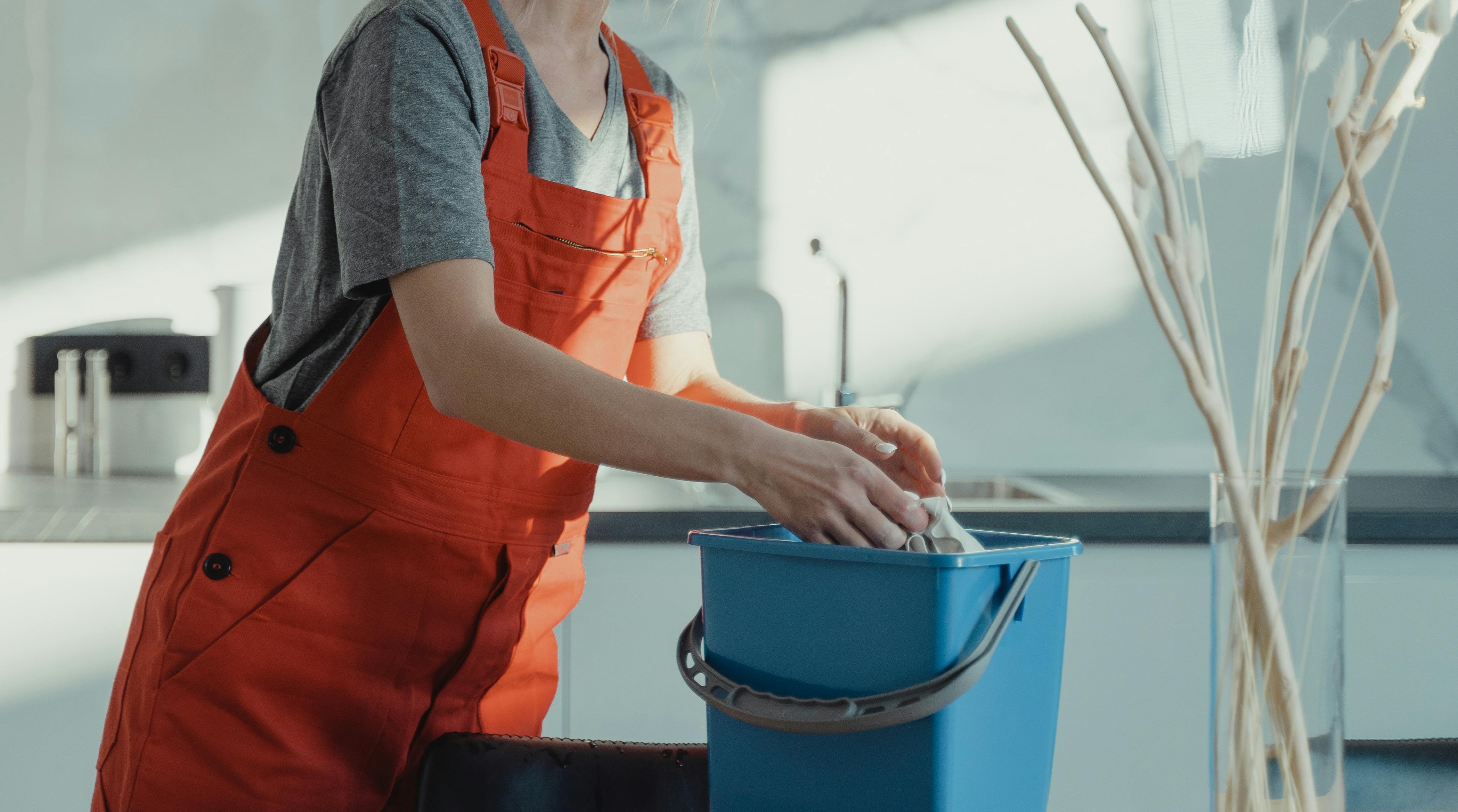
Any type of work activity involves a series of specific risks. For each of these, the potential hazard will be greater or lesser depending on the probability of an accident or undesired event and also the severity of the possible consequences associated. From this perspective, traditionally, occupational risks in cleaning are not considered excessively significant. In other words, it is usually interpreted that cleaning tasks do not involve high-risk activities, speaking in absolute terms of danger.
Despite this widespread idea, it can be seen that there are many risks that can lead to minor or serious work accidents, as shown by the occupational accident statistics of the sector in recent years. These statistics tell us that the average percentage of workplace accidents in the cleaning sector is distributed as follows.
Falls from height caused 18% of total accidents in the sector. Half of them, 9%, are ladder-related falls, and the other half are non-ladder falls. 14% of accidents were due to overexertion, and the same proportion, another 14%, due to slips and trips on the same level. Cuts and punctures accounted for 10% of the total, and impacts in general 9% of accidents. In addition to these, and to a lesser extent, there were also entrapments, collisions, burns, inhalation of toxic products, and electrocutions.
But in addition to these risks that cause work accidents, there are many others that cause common illnesses and occupational diseases. For example, musculoskeletal disorders, which are the main cause of sick leave in the sector. As we all know, cleaning tasks are very repetitive, often performed with manual tools, requiring excessive effort and awkward postures.
The use of chemical products is another important risk factor in the sector, depending on the exposure risk, the concentration of the chemical product, and how it is used.
And what about psychosocial factors, many cleaning workers perform their tasks outside normal working hours and are not part of the permanent staff. These schedules leave them excluded from the social network established among workers at a workplace. Moreover, they often suffer unfair treatment from other workers or must endure exhausting, time-pressured workdays, as in the case of cleaning in hospitality.
Given the above, it can be said that claiming cleaning is a low-risk activity may be somewhat risky.
As we can deduce, due to the varied catalog of occupational risks in cleaning, preventive measures and safety recommendations for each of them could fill a monograph. However, we can make a series of general recommendations to help avoid unsafe acts in cleaning workplaces.
For example, to avoid risks related to falls from different levels, it is advised to use only portable ladders in good condition, and if they are more than 5 meters long, ensure their absolute strength. In this regard, if work is carried out above 3.5 meters, safety harnesses or similar equipment should be used. Of course, improvised items such as stacks of drawers, tables, or radiators should not be used. If the ladders are fixed, any observed defects should be reported, and they should be maintained in perfect order and cleanliness.
Regarding scaffolds and mobile work platforms, they must be mounted on level and stable bases, used according to the manufacturer’s instructions, and maintained in orderly and clean conditions. For lifting equipment, it should be checked that it is in good condition, that the load is evenly distributed on the basket base, that the maximum recommended weight is respected, and it should not be used in adverse weather conditions.
Regarding same-level falls, since slips and trips usually occur due to lack of order and cleanliness, the rule is to maintain good housekeeping at the workplace. Objects should not be left in walkways or areas not intended for them. Spills and liquid leaks should be cleaned promptly and the presence of wet floors signaled. Broken materials and waste should be placed in designated areas.
Concerning electrocution prevention, only electrical equipment without defects in protections, wiring, or plugs should be used. Disconnection should be done by pulling the plug, not the cable, and in case of malfunction, the maintenance supervisor must be notified immediately. Protective elements and any guards on the equipment must always be respected.
There is a wide variety of cleaning products whose chemical composition represents a series of hazards during handling, which can cause burns, splashes, eye injuries, and inhalation of corrosive and irritating vapors.
Regarding risks from using chemical products, this information is provided on the label and expanded through the International Chemical Safety Sheet (FISQ).
Having the FISQ for the products used is mandatory in the cleaning sector. This allows employers to establish safe work procedures and take measures to control and reduce risk. It also helps provide workers with information beyond what is on the label. This sheet must be provided with the first delivery of a hazardous chemical product. It consists of 16 sections that include available information according to regulatory guidelines.
The main functions of the Safety Sheet are to provide data to identify the product and the person responsible for its distribution. It also provides a phone number for emergency inquiries. The FISQ must inform about the product’s hazards and risks regarding flammability, stability and reactivity, toxicity, potential injuries or harm from inhalation, ingestion, or dermal contact, first aid, and ecotoxicity.
The main ergonomic issues in cleaning tasks arise from posture, task repetitiveness, work pace, and applied forces. General recommendations include using both hands during cleaning, performing smooth, continuous movements rather than straight movements with abrupt changes of direction, avoiding excessive bending of the spine, keeping the body upright to properly distribute weight and prevent permanent spinal deformities. Remaining in the same position for too long is not recommended, and gentle stretching every hour is advisable.
Regarding manual handling of loads, mechanical means should be used whenever possible. If the load can only be handled manually, determine its weight, shape, and grip difficulty and adopt appropriate measures. Approach the load so its center of gravity is as close as possible to the body’s center of gravity, keeping feet apart with one slightly forward for balance. In this position, firmly grasp the load with palms and fingers, keeping arms close to the body so it bears the weight. Maintain a straight back and slightly lowered head to reduce injury risk.
Of course, bend the legs and knees when lifting so that the legs’ muscles do most of the work, not the back. Avoid twisting the body with the load, and if turning is necessary, move the feet while keeping the torso straight facing the destination of the load.
The above outlines occupational risks in cleaning and general preventive measures found in daily practice and technical literature. We could even go further into highly specific cleaning tasks, such as vertical work, which requires specialized training and preparation, often at great heights. Biological risks in certain environments, such as hospitals, health faculties, or health centers, are also relevant and will be addressed in another dedicated article.
What we wanted to make clear in this article is that occupational risks in cleaning, in normal daily tasks, are much more significant and numerous than generally believed.


.jpg)
.jpg)
.jpg)