Payroll model: components and how to understand it
November 15, 2023
María Vico
We all look forward to it every month — it’s always welcome and, unlike some visits, we try to make it last as long as possible. What is it? Exactly, the paycheck, that document that assigns each worker their remuneration and must be issued along with proof of payment to certify that the company has fulfilled its duty. However, almost no one takes the time to look at every section of their payslip, since, in many cases, we don’t understand them.
Would you like to learn how to read each section of your payslip and know the different types that exist? Keep reading this post and find out everything!
How many types of payslips are there?
There are mainly two categories of payslips: those based on time worked and those determined by the position held. Let’s now take a closer look at each one.
Time-based payslips
Weekly payslip: the worker receives their payment every seven days.
Biweekly payslip (every 14 days): the worker is paid every two exact weeks.
Fortnightly payslip: this is when the worker receives their payment twice a month.
Monthly payslip: this is the most common one in Spain, paid monthly, either at the beginning or end of each month (28, 29, 30, or 31 days).
Position-based payslips
Executive staff payslip: this applies to the top management positions in an organization, such as executive directors and department heads. It includes more sensitive information such as bonuses, incentives, or other aspects related to their position, and therefore requires greater confidentiality.
Employee payslip: this is the standard payslip given to company employees. Some organizations classify and group these payslips according to each employee’s job role.
What elements appear on a payslip and what does each one mean?
Company information: company name or business name, address, tax ID (CIF), and social security account number.
Employee information: full name, ID or residence number (DNI/NIE), social security affiliation number, hiring date, seniority date, professional group, category, type of contract, and bank account number.
Settlement period: the time frame the payment covers, usually one calendar month.
Salary items: the amounts the employee receives for their work, such as base salary, salary supplements, overtime, bonuses, etc.
Non-salary items: the amounts the employee receives for other non-salary concepts, such as per diems, transportation expenses, compensations, social benefits, etc.
Deductions: the amounts deducted from the employee’s gross salary for various reasons, such as social security contributions, income tax (IRPF), advances, garnishments, etc.
Net pay: the amount the employee actually receives in their bank account after deductions from the gross salary.
Contribution bases: the amounts used to calculate social security and tax contributions, which may vary depending on which concepts are included or excluded.
Company and employee signature and stamp: these certify both parties’ agreement with the content of the payslip. The employee’s signature is not required if payment is made via bank transfer.
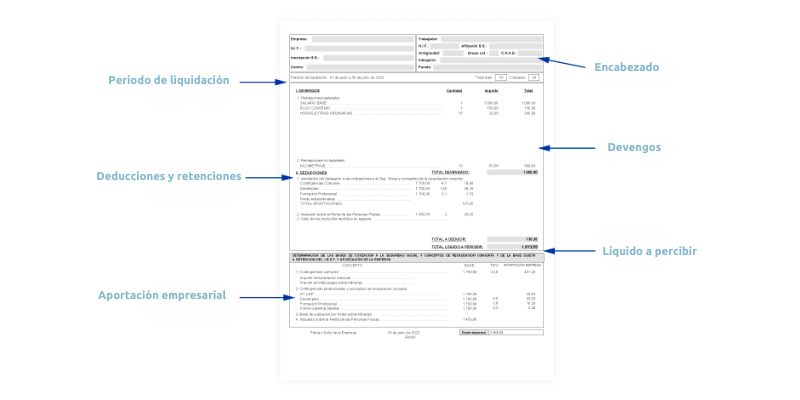
Example of a payslip with its sections
To wrap up this post, we want to show you this payslip example so that when you receive yours, you can easily locate each section.
Employee data privacy protection in payslips
When preparing payslips, confidential employee information is used, so to ensure data protection during the process, the following aspects must be considered under the General Data Protection Regulation (GDPR) and the Organic Law on Personal Data Protection and Guarantee of Digital Rights (LOPDGDD).
Pseudonymization: in the event of a security breach, it must be ensured that it is not possible to identify to whom the data belongs.
Data encryption: payroll management systems must use encryption codes to protect employees’ personal data.
Access restriction: it is essential to focus on preventing third-party attacks and preventing hackers from accessing payrolls or databases storing confidential information.
Data minimization: only the personal data strictly necessary to process payroll should be stored and handled.
We hope you found this post useful. Keep learning more about HR, professional development, and business management with Educa.Pro!