
For years, office work took place solely within four walls, with employees confined to a static and often isolated environment. However, as time went on, many professions began to require an alternative to the constraints of the office. This led to the emergence of the coworking, is an innovative physical space that capitalises on the benefits of a dynamic and collaborative working environment.
The approach of the coworking It has gained popularity amongst many professionals, from freelancers and entrepreneurs to small businesses and corporate teams, who find here a shared space that promotes the collaboration, flexibility and creativity. That said, beyond the trend and, at times, the posturing with a coffee in hand, is co-working actually useful? We’ll be discussing this topic in the following sections.
Features of co-working
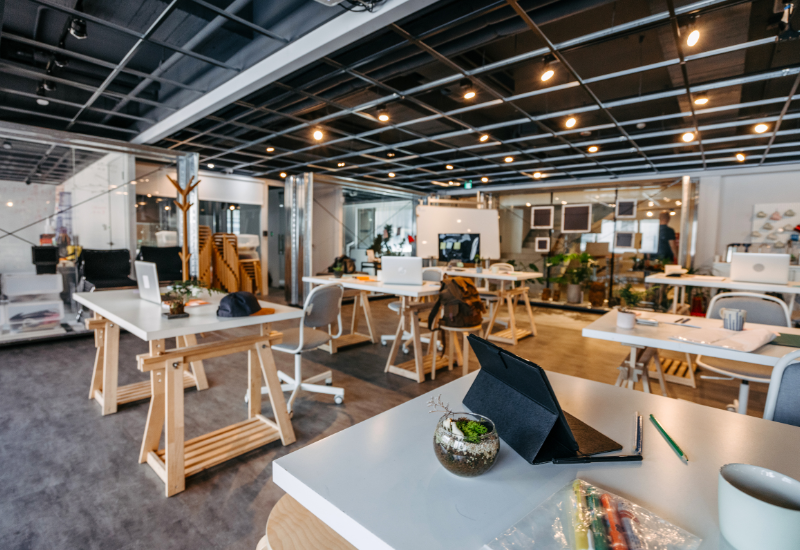
As we mentioned earlier, the coworking is a working model in which self-employed professionals, freelancers, entrepreneurs and small businesses they share a communal office space. This concept offers a a flexible and collaborative alternative the traditional model of working in a private office or from home.
These are the main features of co-working:
- Shared spaces: Members have access to open-plan workspaces where they can hire a desk for a day, a week or a month.
- Flexibility: Coworking spaces offer flexible contracts, allowing users to choose the duration and type of membership that best suits their needs.
- Community and networking: One of the main advantages of co-working is the opportunity to connect with other professionals from different sectors. This fosters collaboration and the exchange of ideas.
- Events and workshops: Many organisations run events, workshops and networking activities for their members. This helps to facilitate professional development and networking.
Services offered at a co-working space
Another feature that makes co-working spaces so popular is the range of services they offer. Although these may vary depending on the provider and the type of space, they usually include facilities and resources designed to meet the needs of the professionals who use the space. Let’s take a look at the most common services:
- Shared workspaces: Shared desks in open-plan areas, suitable for individuals or small teams looking for a collaborative working environment.
- Private or semi-private offices: dedicated spaces that can be hired by larger teams or individuals who prefer more privacy.
- Rooms in meetings: spaces equipped with conference technology and suitable furniture for meetings, presentations and group work sessions.
- High-speed connectivity: High-speed internet access to ensure a reliable and fast connection for work-related activities.
- Printing and scanning services: Printing, photocopying and scanning facilities are available for members’ use.
- Rest areas: spaces designed for relaxing, socialising or taking a break between tasks.
- Coffee shop or kitchen area: facilities for making coffee, tea and light refreshments, as well as dining areas where you can enjoy meals or snacks.
- Reception and administrative services: reception staff to welcome visitors, handle post and provide basic administrative support.
- 24/7 access: Some co-working spaces offer 24-hour, 7-day-a-week access to accommodate flexible working hours.
Five types of co-working
Are you already thinking about working from a co-working space? If so, it’s important to know that there are different types of infrastructure, each with its own unique characteristics and benefits. Here are five very popular ones:
General-purpose co-working space
These are co-working spaces that are open to a wide range of professionals and businesses, regardless of their sector or industry. They are ideal for freelancers, entrepreneurs and small businesses looking for a collaborative and diverse working environment.
Industry-specific co-working
They focus on meeting the needs of a specific sector or industry, such as technology, design, healthcare or finance. They offer resources, events and networking tailored to the needs of that particular sector.
Coworking for start-ups
They are specifically designed to support start-ups and emerging businesses, offering resources and services that can help accelerate their growth and success. These may include access to investors, mentors, accelerator programmes and networking events.
Rural co-working or remote areas
They are situated in rural or remote areas, far from the big cities. They are ideal for those seeking a peaceful, natural environment in which to work, or for those who wish to escape the hustle and bustle and the high cost of living in urban areas.
Benefits of co-working
Nowadays, many professionals choose co-working spaces to carry out their work or give free rein to their creativity. These are the benefits of co-working that make it so popular:
- Reduced costs: Sharing a workspace reduces operating costs compared with renting a private office.
- Flexibility and mobility: Coworking spaces allow professionals to work in different locations without long-term commitments, which is ideal for those who travel frequently or prefer a change of scenery.
- Productivity and motivation: Working in a professional and dynamic environment boosts productivity and motivation, whilst helping to avoid the common distractions associated with working from home.
- Access to resources and services: Coworking spaces provide access to equipment and services that might otherwise be expensive or difficult to obtain.
- Opportunities for collaboration: Being in close proximity to other professionals and businesses fosters collaboration, the creation of synergies and the opportunity to form strategic alliances.
Is co-working useful?
At this point, let’s answer the question we posed at the start: is co-working useful? If we look at the advantages mentioned above, we could say yes, but the truth is that this is a working model that doesn’t suit everyone. For example, if you need to work with sensitive or confidential tasks Perhaps this isn’t the best environment. Open-plan offices and communal areas can be prone to interruptions and a lack of privacy.
What’s more, it has a lot to do with your personality and the way you work. Do you get distracted easily? If so, it’s best to look for another option. The coworking space It can be a sociable and lively environment, which can lead to frequent distractions for some professionals. Noise, conversations and social interactions can make it difficult to concentrate and focus on work.
The final drawback we’ve highlighted also relates to personality. The fact is that, when working in a shared environment with people of different personalities, issues may arise interpersonal conflicts or disagreements over the use of the space or the behaviour in the workplace.
If you’d like to learn more about this and many other areas related to collaborative working environments, please do follow us on the blog at Educa.Pro.