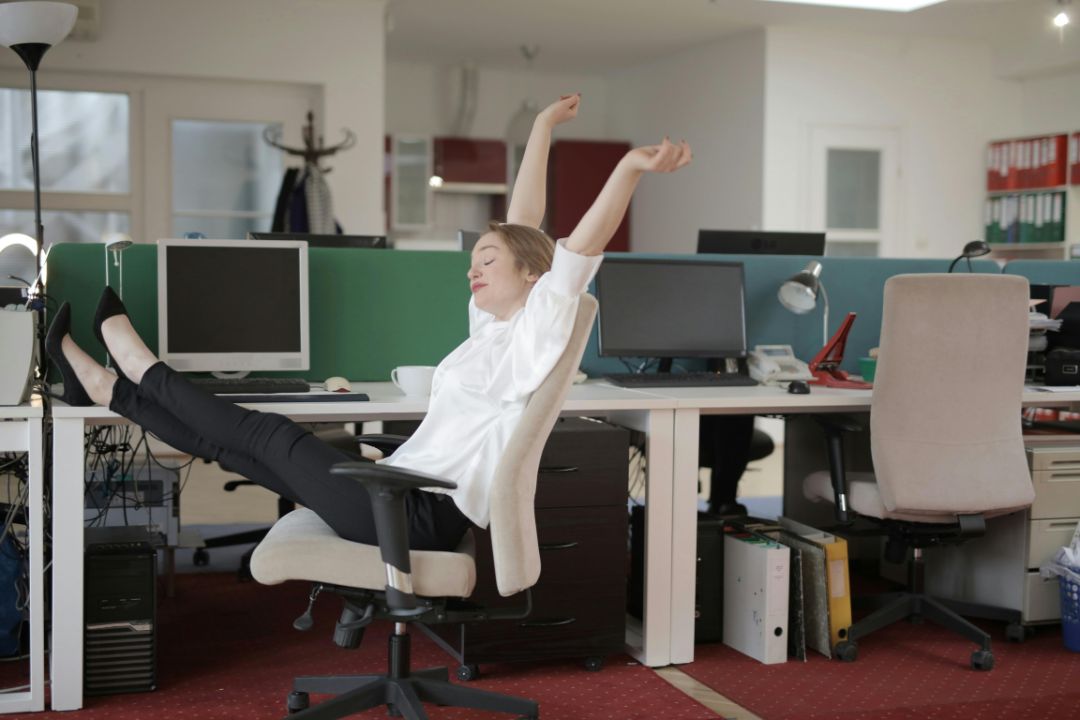
Back or neck pain is very common amongst people who spend long hours sitting down. This problem generally affects office workers and anyone who works at a computer, making it a bit tricky to relieve this pain, as we have to carry on with our daily work routine. Fortunately, there are some exercises, such as office stretches, that you can do easily. If you’d like to find out what they are, read on!
Try these stretches at the office to prevent back and neck pain
As you know, prevention is better than cure, and with the list of stretches and exercises to do in the office that we’ve provided below, that’s exactly what you’ll be doing. However, if you suffer from severe back or neck problems, it’s best to see a specialist.
Don’t miss out on the following list of exercises to do at the office!
Side neck stretch:
- Sit up straight in your chair.
- Gently tilt your head to one side, bringing your ear towards your shoulder.
- Hold the position for 15–20 seconds.
- Repeat on the other side.
- Head rotation:
- Sit in a comfortable position.
- Slowly turn your head to one side, bringing your chin towards your shoulder.
- Hold for 15–20 seconds, then do the same on the other side.
- Lower back stretch:
- Sit in the chair with your feet flat on the floor.
- Cross your arms over your chest.
- Turn your torso to one side, feeling the stretch in your lower back.
- Hold the position for 15–20 seconds, then switch sides.
- Shoulder stretch:
- Sit down or stand with your feet shoulder-width apart.
- Place one arm across your chest and, with your other hand, gently press on your elbow to deepen the stretch.
- Hold for 15–20 seconds, then repeat with the other arm.
Arm and back stretches:
- Place your hands on the desk or a stable surface.
- Walk backwards so that your body forms a 45-degree angle with the desk.
- Feel the stretch in your arms, shoulders and back.
- Hold for 15–20 seconds.
- Trapezius stretch:
- Sit up straight in your chair.
- Bring one hand towards the opposite side of your head and apply gentle pressure to stretch the trapezius muscle.
- Hold for 15–20 seconds, then repeat on the other side.
- Hip flexor stretch:
- Sit on the edge of your chair.
- Step one leg forwards and keep the other leg stretched out behind you, with your foot flat on the floor.
- Lean slightly forwards to feel the stretch at the front of the thigh of your outstretched leg.
- Hold for 15–20 seconds, then switch legs.
What causes back problems?
Back pain can be caused by a number of factors, and almost always, the cause is a combination of several of them. Generally speaking, these are the causes that we all face at some point in our lives:
A sedentary lifestyle: According to studies carried out by the INE on sedentary lifestyles and health in Spain, more than 50% of Spaniards lead sedentary lives, sometimes because of the nature of our work and at other times because of how we spend our free time: whether we spend it sitting down, whether we have more or less active hobbies, or whether we set aside time each day to exercise. When we become accustomed to a sedentary lifestyle, our muscles atrophy, our bones receive no stimulation to help them strengthen, and the risk of cardiorespiratory diseases arises.
Muscle and ligament strain: These occur when we perform repetitive exercises or maintain poor posture for long periods of time. What happens is that the structures become inflamed and put pressure on the nerves, causing that sharp pain.
Ailments of old age: As we get older, our joint structures gradually wear down, a condition known as arthritis. The cartilage, which acts as a cushion between the surfaces that form the joints, wears away, leaving the joints without cushioning.
Overweight: being overweight – from a medical rather than an aesthetic point of view, as the latter is highly subjective – weakens the muscles, which can lead to hernias and protrusions.
Poor nutrition, smoking and alcoholism: Smoking and excessive drinking, as well as an unhealthy diet high in fat, sugar and salt, can lead to reduced blood flow and inflammation of the disc, which will ultimately compress the nerve.
What are the most common musculoskeletal disorders?
Musculoskeletal disorders are the most common work-related conditions. They mainly affect the upper limbs, neck and back; and the following are the most common:
Rotator cuff tendinitis: this is inflammation of the tendons of the shoulder muscles, particularly the rotator cuff, and is usually caused by overuse of the tendons and repetitive movements.
Epicondylitis: also known as ‘tennis elbow’. It is caused by repetitive strain during movement, leading to inflammation of the tendons of the muscles on the outer side of the elbow.
Carpal tunnel syndrome: this is compression of the median nerve as it passes through the wrist, within the carpal tunnel.
Low back pain: This is a painful, persistent muscle spasm that develops in the lower back as a result of overloading it or maintaining the same posture for long periods of time. To prevent this, you must constantly remember to keep your spine aligned with your pelvis and upright.
Cervical tension syndrome: This is another type of muscle spasm that occurs at work. It affects the back of the neck and is caused by work-related strain, repetitive use of the muscles or forced neck postures. Furthermore, it is particularly common amongst workers who maintain this static posture.
Would you like to find out more about postural health and tips on occupational health and safety? Don’t stray too far from our content, as we’ll be continuing to discuss health at work! We look forward to seeing you at Educa.Pro.