
We’re all looking forward to it every month; it’s always welcome and, unlike some visitors, we try to make it last as long as possible. What is it? That’s right, the payslip, that document which sets out each employee’s pay and which must be issued alongside a payment receipt to certify that the company has fulfilled its obligation. However, hardly anyone takes the time to look at every item on their payslip, as, in many cases, we don’t understand them.
Would you like to know how to read each section of your payslip and find out about the different types? Keep reading this post to find out everything!
How many payslip templates are there?
There are essentially two categories of pay: those based on hours worked and those determined by the job held. Let’s now take a closer look at each of them.
Time-based payslips
- Weekly payslip: the worker is paid every seven days.
- Fortnightly payslip: the employee is paid every two full weeks.
- Fortnightly payslip: this is when the employee is paid fortnightly.
- Monthly payslip: this is the most common type in Spain, and it is paid monthly, at the beginning or end of each month (28, 29, 30 or 31 days).
Payroll by job role
- Payroll for executive staff: this is the payslip issued to senior staff within an organisation, such as chief executives and department heads. It contains slightly more sensitive information, such as bonuses, incentives or other aspects associated with their position; these require greater discretion.
- Payroll for employees: this is the standard payslip issued to a company’s employees. Some organisations tend to categorise and group these payslips according to each employee’s job role.
What items appear on a payslip, and what does each one mean?
- Company details: name or company name, registered address, tax identification number and social security contribution account number.
- Employee details: full name, National Identity Card (D.N.I.) or Foreigner Identification Number (N.I.E.), social security number, date of joining the company, length of service, professional group, category, type of contract and bank account number.
- Settlement period: the period to which the payroll payment relates, usually a calendar month.
- Perceptions of pay: these are the amounts an employee receives for their work, such as basic pay, pay supplements, overtime pay, special payments, etc.
- Non-wage benefits: these are the amounts an employee receives for items other than their actual salary, such as subsistence allowances and expenses for transport, the compensation, social benefits, etc.
- Deductions: these are the amounts deducted from an employee’s gross pay for various reasons, such as the quote social security contributions, income tax, advance payments, garnishments, etc.
- Amount to be received: this is the amount that the employee actually receives in their bank account, after deductions have been made from their gross salary.
- Contribution bases: these are the amounts on which social security contributions and income tax are calculated; they may vary depending on which items are included or excluded.
- Signature and stamp of the company and the employee: these are the elements that confirm both parties’ agreement with the contents of the payslip. The employee’s signature will not be required if payment is made by bank transfer.
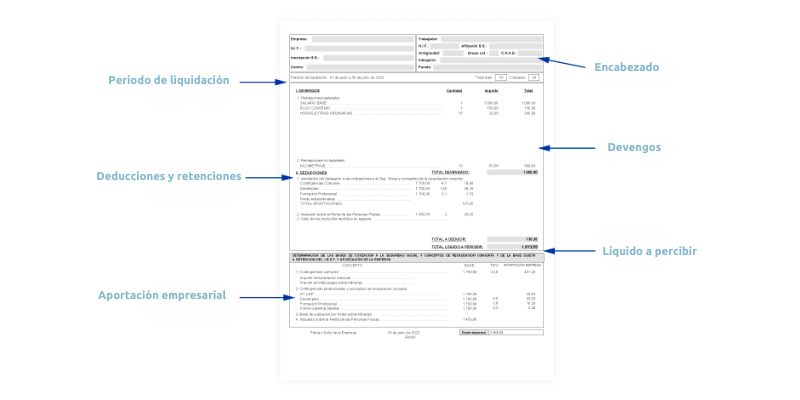
Example of a payslip with its sections
To round off this post, we’d like to share this payslip example with you so that, when you receive yours, you’ll know exactly where to find each section.
Protecting employees’ privacy in payroll
Payroll processing involves the use of confidential information relating to each employee; therefore, to ensure data protection throughout the process, the following aspects, which are subject to the General Data Protection Regulation, are taken into account: Data Protection (GDPR) and the Organic Law on the Protection of Personal Data and the Guarantee of Digital Rights (LOPDGDD).
Pseudonymisation: in the event of a security crisis, steps must be taken to ensure that the identity of the data subjects remains unknown.
Data encryption: IT systems used for payroll management must incorporate encryption to ensure the protection of employees’ personal data.
Access restrictions: it is essential to focus on preventing attacks by third parties and ensuring that hackers cannot gain access to payroll records or databases containing confidential information.
Data minimisation: Only personal data that is essential for carrying out payroll processing should be stored and processed.
We hope you’ve found this post useful. Keep learning more about HR, professional development and business management with Educa.Pro!